Nobody told you what a Skill is (yet).
Almost every architect and PM is still using AI like a search bar. The ones who aren't have quietly opened up the biggest productivity gap in the profession.
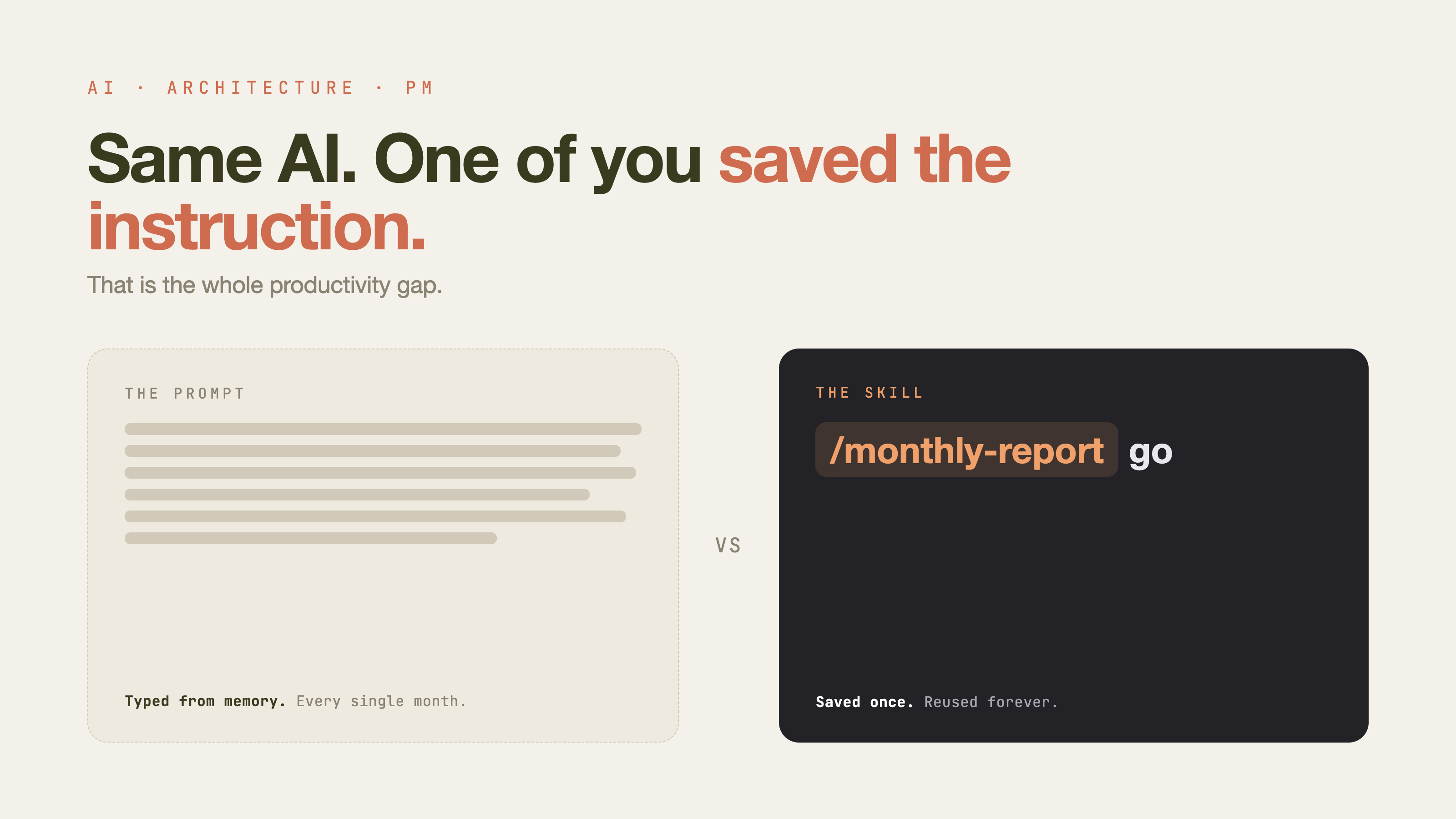
Ask a room of architects and PMs what a Claude Skill is, and almost none of them can tell you.
Not a prompt. Not a chatbot. A Skill.
That blank look is the gap. Because the people who do know are getting the same work done in a fraction of the time, with the same tools everyone already has open.
This is the plain-English version. What a Skill is, why it changes the maths of a practice, and where to get good ones without building from scratch.
01Most people are still on step one
Here is how nearly everyone uses AI today.
Open a chat. Type a request. Read the answer. Close the tab.
Tomorrow, start from zero. Type it again. Slightly differently. Get a slightly different answer.
That works. Barely. It treats a tool that can remember a process like a vending machine you feed coins into every single time.
A Skill is the next step, and almost nobody has taken it.
02So what is a Skill, actually
A Skill is a saved instruction the AI reuses on command.
You teach it your task once. What to read. What format to follow. What rules to never break. You give it a name. From then on, you call it by that name.
Under the hood it is refreshingly boring: a small folder with a plain-text file inside, written in the same language you would use to brief a graduate. No code. You can read every line of it.
The prompt is the throwaway. The Skill is the asset.
That single distinction is the whole idea. A prompt is something you spend. A Skill is something you own, and it compounds every time you use it.
03What it changes for a practice
Think about the documents your week is actually made of. The recurring ones. The ones you rewrite from a slightly different blank page every time.
Each one is a Skill waiting to be saved.
- The monthly progress report. A 200-word prompt, retyped every month → /monthly-report go
- The tender response. Follows your firm's structure, every time, without a reminder.
- Meeting minutes. Come out in your format, with actions and owners, not the model's guess at a layout.
- The zoning or NCC pre-check. Runs the same way whether you press go or a graduate does.
- The scope-creep email. Firm, polite, and consistent, drafted the same way every time it is needed.
None of this needs a smarter model. It needs the same model, with your knowledge saved inside it.
Worked example See one built end to end: the monthly progress report, from prompt to /monthly-report go The full instruction, the copy-paste prompt, and a ready-made SKILL.md.04The gap, in one line
Two people. Same subscription. Same model.
One writes the instruction once and saves it.
The other retypes it every time, from memory, forgetting a rule or two on the way.
Over a year, that is not a small difference. It is the difference between a firm that files the same report in an afternoon and one that loses a day to it, twelve times.
The quiet part: the firms pulling ahead this year did not adopt anything exotic. They just stopped writing the same document twice.
05You don't start from a blank page
Before you write your own, look at what already exists. There is a growing, open shelf of Skills you can read, fork, rename, and point at your own files.
github.com/anthropics/skills Anthropic's own open-source Skills, including the document skills for Word, Excel, PowerPoint and PDF. The cleanest model for how a SKILL.md is written. github.com/anthropics/claude-cookbooks Worked patterns for getting reliable, repeatable output. Good for understanding why a well-written Skill behaves.Beyond those, there are community collections built specifically for architecture and construction: visualisation, modelling, planning and code pre-checks, cost and programme, specs and submissions. Curate first. Build only what is missing.
Where it falls short
A Skill does not add judgement. It repeats your instruction faithfully, mistakes included. A badly written one is just a fast way to be wrong every single time.
So you still write it properly once. And you still read what comes back, the same way you would check a graduate's drawing.
The tool remembers the process. You still own the decision.
The prompt era is ending. The people who save their work are about to move a lot faster than the people who retype it.
Start with the document you dread most.
Comment "Skills" and I'll show you how to turn one of your recurring documents into a custom Skill, step by step.
And if a colleague still thinks a Skill is just a longer prompt, send them this.