You're briefing Claude like a search bar. Brief it like a graduate architect.
3 habits that quietly waste 40 minutes, the 3 moves that replace them, and the 6 prompts. Free, no email wall.
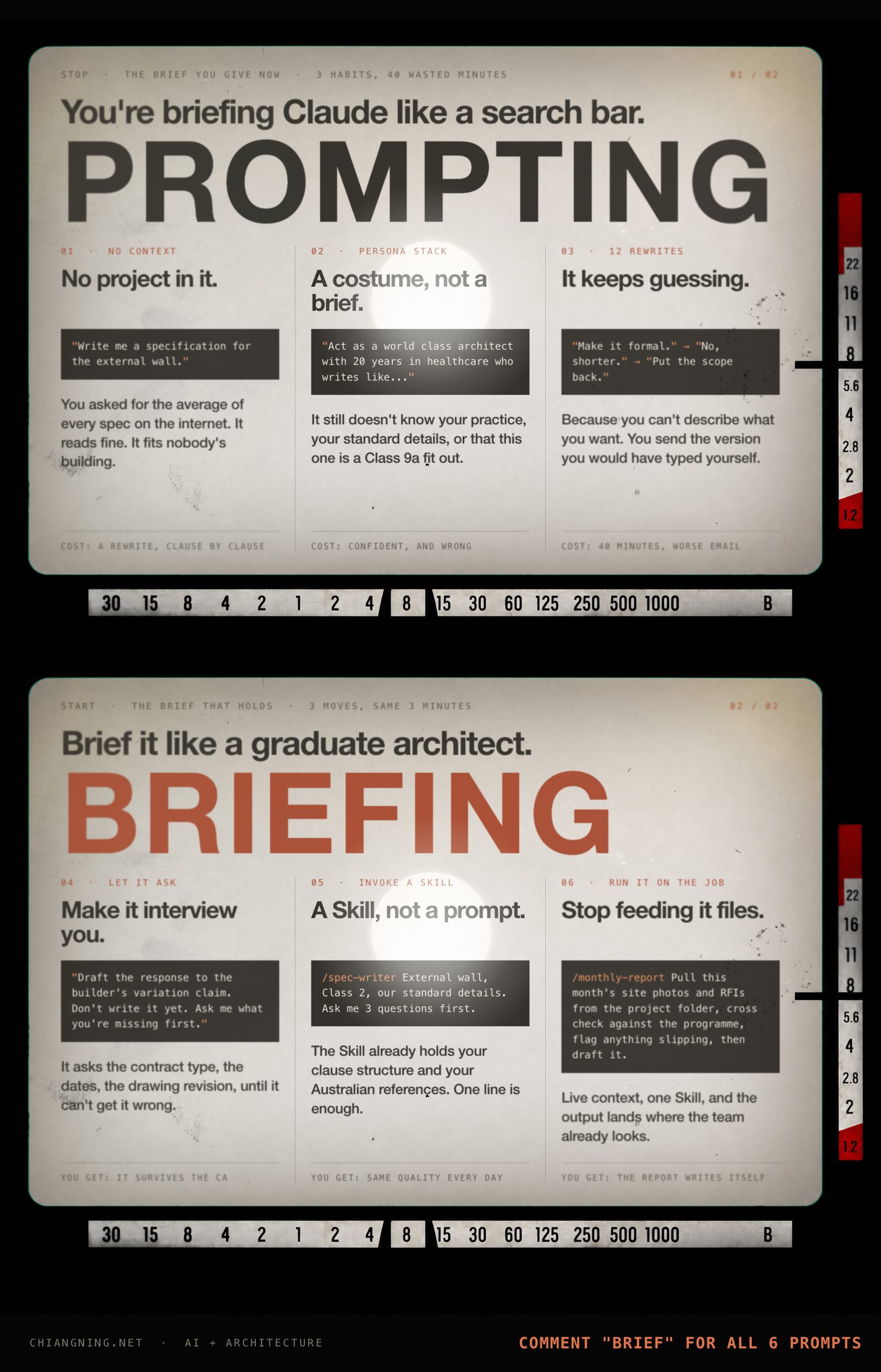
You can tell what someone thinks AI is by watching the first ten seconds.
They type four or five words. They hit enter. They read what comes back, decide it is generic, and quietly conclude the tool is overrated.
That is the search-bar habit, and almost everyone still has it. Twenty years of Google taught us that the input box wants keywords, that shorter is smarter, and that typing a whole paragraph is the mark of someone who does not know how to search. All three are true of Google. All three are wrong here.
Because this is not a search engine. It is closer to a very fast, very well-read graduate who started this morning, has read every Standard ever published, and knows absolutely nothing about your job. Google rewards the shortest possible input. A graduate rewards the fullest possible brief. Keep treating the second like the first and you will spend a year getting search results out of something that could have run your progress claim.
What follows is the 3 habits that waste the most time, then the 3 moves that replace them, with the actual prompts. Everything here works today, in a normal week, on a live job.
Part one · the 3 habits
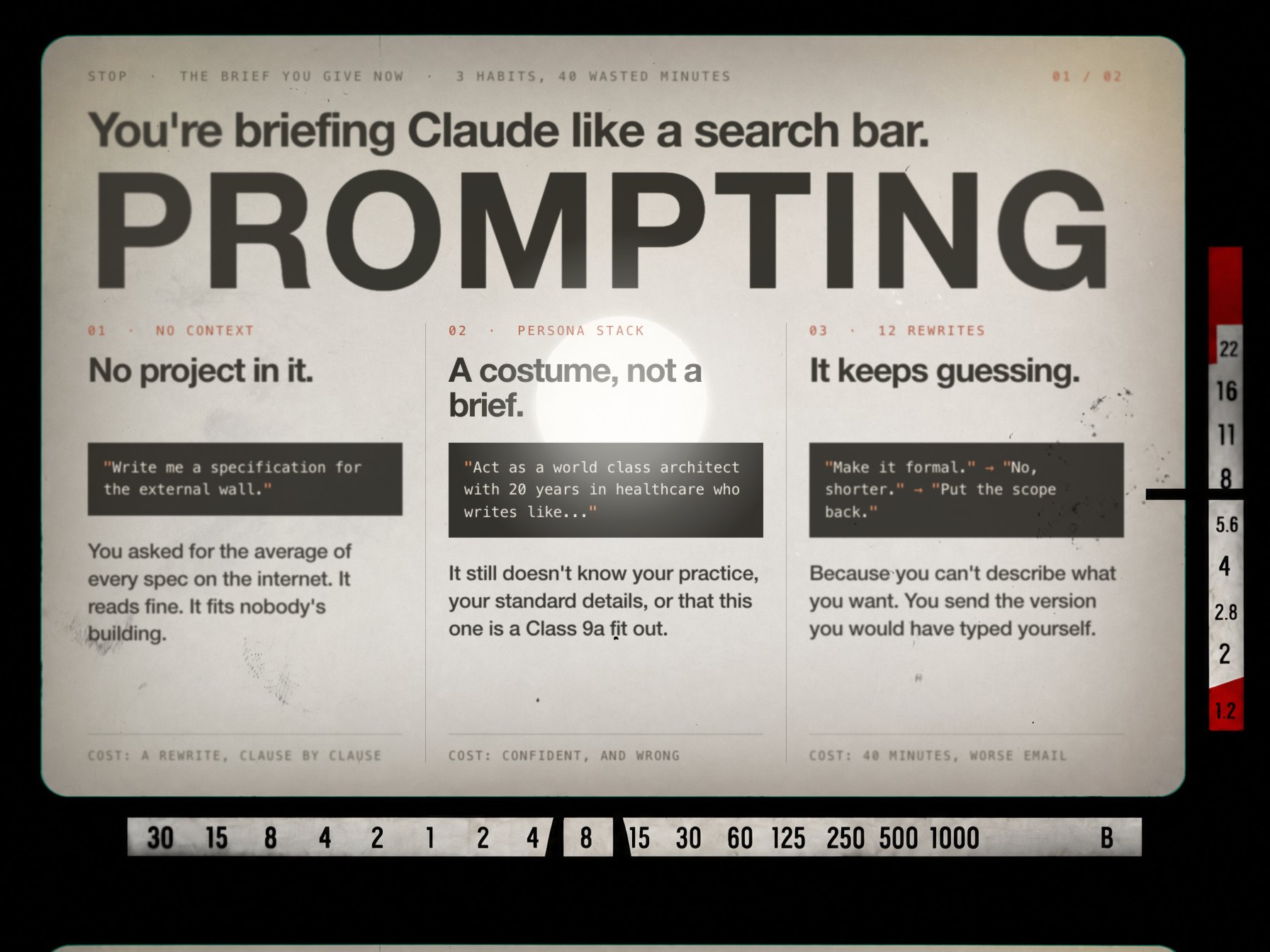
Habit 01 · No contextThere is no project in it
The most common prompt in our industry, and the one that teaches people AI is useless.
"Write me a specification for the external wall."
Read that back as a request to a person. No substrate. No climate zone. No NCC class. No acoustic or fire requirement. No mention of the standard details your office has used for fifteen years. Nobody could answer it well, so nobody does.
What you actually asked for was the average of every external wall specification on the internet, and that is precisely what came back. It reads well. It is not wrong. It fits nobody's building, including yours.
Then the real cost arrives. You do not throw it away, because it looks close. You edit it. Clause by clause, in someone else's structure, which takes longer than writing it from your own template would have.
Cost: a rewrite, clause by clause.
I need a draft external wall specification for a live project. Use
Australian standards and Australian English.

THE PROJECT
- Building type and NCC class: [e.g. 4 storey residential, Class 2]
- Location and climate zone: [e.g. Parramatta NSW, zone 5]
- Wall build-up, outside in: [e.g. face brick / 40mm cavity /
  breather membrane / 90mm steel stud / R2.5 batts / 13mm plasterboard]
- Performance it has to meet: [e.g. Rw+Ctr 50 to the street,
  90/90/90 FRL, condensation per NCC F8]
- What is already decided and must not change: [e.g. brick
  selection, window system]

HOW WE WRITE IT
- Follow the clause order in this example of ours: [paste one
  spec section you are happy with, or attach it]
- Reference the actual Standards by number. Never invent a clause.
- Anywhere you are unsure or a decision has not been made, write
  [CONFIRM] and say what you need. Do not fill the gap yourself.

Give me the draft section, then a short list of every [CONFIRM].
Why this works: nothing in it is clever. It is just the brief you would give a graduate, typed out. The last rule is the important one. Left alone, a model fills a gap rather than admitting it, and on a live job an invented gap becomes a number a builder quotes back at you.
Habit 02 · The persona stackA costume, not a brief
This one is the hardest to give up, because the internet spent three years teaching it as the answer.
"Act as a world class architect with 20 years in healthcare who writes like a technical author and thinks like a project manager..."
In 2023 that was worth something. Models were weaker and needed steering into a domain. Today it is decoration. You have changed the register of the writing, not the knowledge behind it.
Because after all twenty years of imaginary experience, it still does not know your practice, your standard details, or that this one is a Class 9a fit out with the ward staying operational through the works. The costume is the whole problem: it makes a thin answer sound authoritative, so it slides through your review instead of catching your eye.
Try the swap. Delete every word about who it should pretend to be, and spend those same words on what is actually true about the job. The answer improves immediately.
Cost: confident, and wrong.
Drop any persona. You do not need to be anyone. Here is the job.

WHAT I'M DOING
[e.g. Responding to the head contractor's claim for an extension of
time on a hospital ward upgrade.]

THE FACTS THAT MATTER
- Contract: [e.g. AS4000-1997]
- Dates: [claim received, delay period claimed, current date]
- What they say caused it: [their stated cause]
- What I believe actually happened: [your view, in plain words,
  including anything that is genuinely our risk]
- Constraints nobody can move: [e.g. ward stays operational,
  no work after 8pm]

WHAT I WANT BACK
A position, not a letter. Set out: what the contract actually
entitles them to here, which of their grounds hold and which do not
and why, what evidence I should have in hand before I respond, and
where our own exposure sits. Australian English, no filler.

If a fact you need is missing, ask me for it instead of assuming it.
The tell: if your prompt would still read the same way on a completely different project, it has no facts in it, only costume. Facts do not travel between jobs. That is how you know they are doing the work.
Habit 03 · 12 rewritesYou send the version you would have typed anyway
Forty minutes, gone, and a worse email at the end of it.
"Make it formal." → "No, shorter." → "Less aggressive." → "Put the scope back in." → "Actually go back to the second one."
Each of those is a description of what was wrong with the last answer. None of them is a description of what a good answer looks like. So the model guesses, you react, it guesses again, and the two of you take turns being vague at each other.
Here is the uncomfortable part. Usually the reason you cannot describe what you want is that you have not decided yet. You are using the rewrites to think, which is a legitimate thing to need and a very slow way to get it. Forty minutes later you send something close to what you would have typed cold, and the whole exercise cost you the time it was supposed to save.
The fix is to stop asking for one answer. Ask for a small spread of real options in a single pass, then make one decision.
Cost: 40 minutes, worse email.
Before you write anything: I am not sure yet what tone this needs, so
give me the choice rather than one attempt.

THE SITUATION
[e.g. The client has gone quiet on a variation we've already
instructed. Money is committed. I need it approved without picking a
fight, and the relationship is worth more than this variation.]

WHO IT GOES TO
[e.g. Client's facilities manager. Not technical. Reports to a
board that hates surprises.]

WHAT MUST BE IN IT
[e.g. the amount, the reason it arose, the date I need a decision
by, and the consequence of no decision.]

Give me three versions of the same email, clearly labelled:
A. Straight and factual
B. Warm, relationship first, the ask at the end
C. Firm, with the commercial consequence stated plainly

Each under 150 words. Then tell me in one line which you would send
and why. Do not blend them.
The rule I use: if I am on my third rewrite, the problem is not the wording. I stop editing and go back to describing the outcome. Every time I have ignored that rule it has cost me half an hour.
Part two · the 3 moves
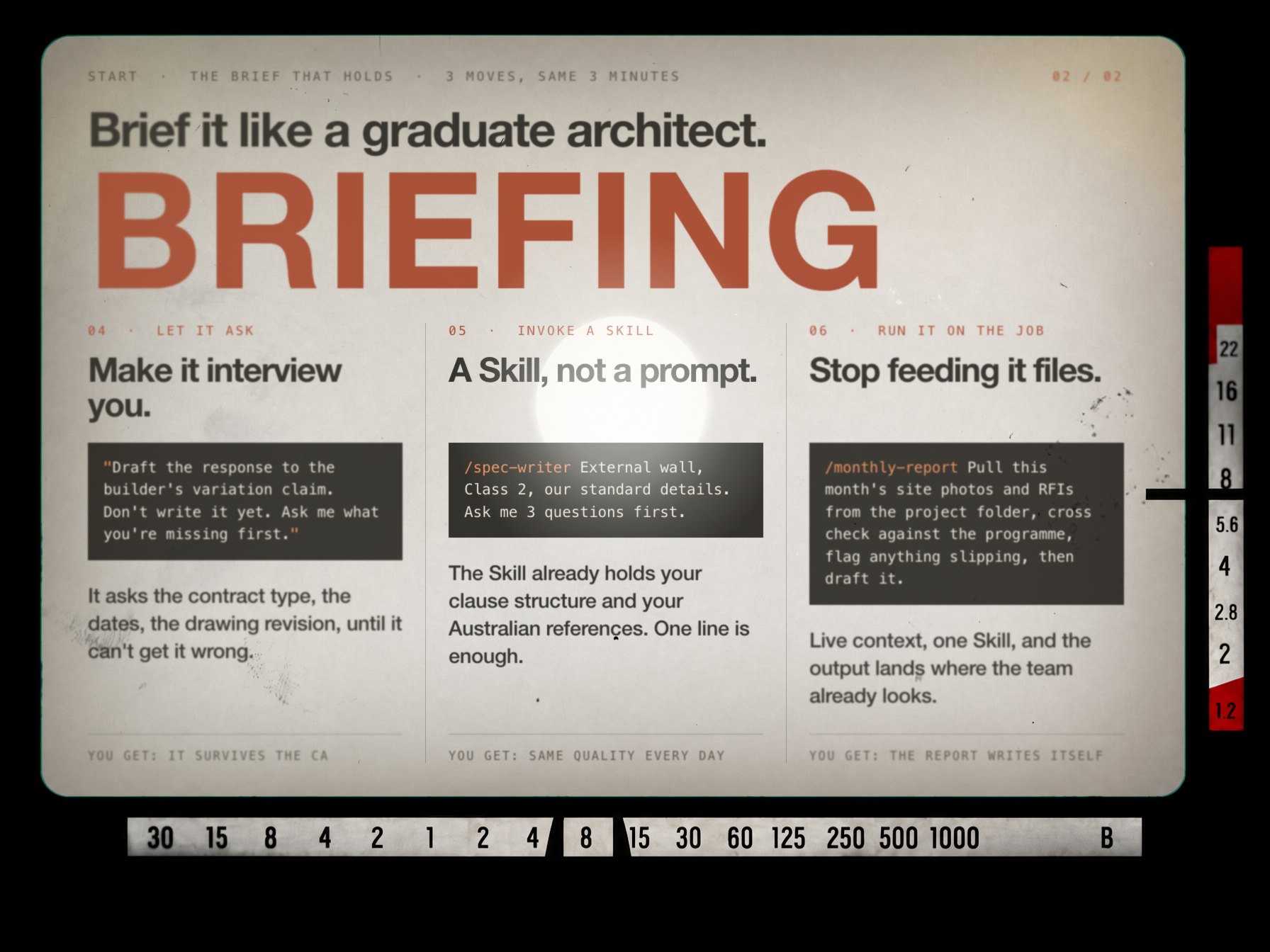
Move 04 · Let it askMake it interview you
The single highest-value habit on this page, and it is one sentence long.
Add this to the end of anything: "Don't write it yet. Ask me what you're missing first."
Everything changes. Instead of a confident draft built on invented assumptions, you get questions. The contract type. The date the claim was received. Which drawing revision was current. Whether the delay overlapped the shutdown. It asks until it cannot get it wrong, and answering five questions takes less time than finding five wrong assumptions buried in a finished draft.
Models are good at knowing what they do not know. They just are not in the habit of saying so, because they have been trained to be helpful, and helpful looks like answering. Give it permission to ask and it takes it.
I want your help with this, but I know I am about to under-brief you.

THE TASK
[e.g. Draft our response to the builder's variation claim for the
substation relocation.]

WHAT I CAN TELL YOU NOW
[dump everything you know, in any order, unpolished. Bullet
points, half sentences, contradictions, all fine.]

Now stop. Do not write the response yet.

Ask me the questions you need answered to get this right the first
time. Number them, most important first, and cap it at eight. Where
your question has an obvious set of likely answers, list them so I
can just pick one. If something in what I've told you contradicts
itself, say so.

When I've answered, draft it, and flag anything you are still
assuming.
The one mistake: answering all eight in one wall of text. Answer them numbered, in order. Half the value of the interview is that it makes you decide things in sequence, which is exactly what you were avoiding when you typed four words into the box.
You get: a draft that survives contract administration.
Move 05 · Invoke a SkillA Skill, not a prompt
The move that ends prompt writing for the tasks you repeat.
A Skill is your office procedure written down once and given a name. After that you call it, and the context arrives with it.
/spec-writer External wall, Class 2, our standard details. Ask me 3 questions first.
One line replaces the whole page from Prompt 01, because the clause order, the Australian references, the tone and the [CONFIRM] rule are in the file, not in your typing. You are not being terse. You are being brief because the context is already there.
This is also why the answer is the same quality on a Friday afternoon as it is on a Tuesday morning, and the same whoever in the office runs it. A prompt is a performance. A Skill is a procedure.
Help me turn a task I repeat into a reusable Skill.

THE TASK
[e.g. our external wall specification sections]

I have just done one by hand. Here is the finished piece, and here is
what I corrected along the way:
[paste the output you were happy with, plus the corrections you
made and why]

Do this:
1. Ask me the 5 questions you need to understand how I actually do
   this, not how it should be done in theory.
2. Then write it up as a procedure you can follow every time: what
   to ask me for, what to read, the order of the output, the tone,
   the Australian references to use, and what to check before handing
   it back.
3. Include the rule that anything undecided is marked [CONFIRM] and
   never invented.
4. Keep it short enough that I will actually reuse it.
New to this, start with What is a Skill. Then the 25 Claude Skills for Architects and PMs, the construction PM pack, and the monthly report Skill built step by step. Every one links to its real home. No email wall.
The one mistake: writing the Skill from memory, before you have run the job once. You will describe the tidy version you wish you did. Run it by hand, corrections and all, then have it write down what actually happened.
You get: the same quality every day.
Move 06 · Run it on the jobStop feeding it files
The move most people have not tried yet, and the one that changes the size of what you can hand over.
Everything above still assumes you are pasting things in. You do not have to. Point it at the project folder and it opens the real files itself: this month's site photos, the RFIs, last month's minutes, the programme, the QS spreadsheet.
That is when the request stops being about text and starts being about work. Not advice about the monthly report. The monthly report.
[Point Claude at the project folder, then:]

Draft this month's project report.

READ
- The site photos and site instructions in [/folder]
- Every RFI raised or answered since [date]
- Last month's report, and match its structure exactly
- The current programme [/file]

DO
- Cross check progress on site against the programme, and flag every
  item that has slipped, with how many days and the source you got
  it from
- List RFIs still open past [14] days, oldest first
- Note anything in the photos that contradicts what the report from
  last month said would happen

RULES
- Every number traceable to a file. Name the file.
- If the folder does not tell you something, write [NOT IN FOLDER].
  Do not estimate.
- Do not overwrite last month's report. New file, dated.

Then give me a five line summary I can read before the PCG.
The one mistake: describing keystrokes instead of outcomes. Say "cross check progress against the programme and flag what slipped", not "open file A, copy column B into file C". You are the judgment. It is the hands.
You get: the report writes itself, and you check it.
The one habit underneath all six
The poster is a camera viewfinder for a reason.
A prompt with no context is a lens wide open. Bright, fast, easy, and nothing in the frame holds focus. Every fact you add stops it down: the NCC class, the contract, the date, the constraint that cannot move, the example of how your office writes. The depth of field gets deeper until the whole answer is sharp from front to back.
Notice that none of the three moves takes longer to type than the habit it replaced. "Ask me what you're missing first" is nine words. The Skill call is one line. The folder brief is shorter than the twelfth rewrite of an email. Same three minutes. The difference is entirely where you spend them: in front of the answer, or behind it.
You are not underusing AI because you know too few prompts. You are underusing it because you give it less than you would give a graduate on their first morning.
And a graduate, given a real brief, does not just come back with the document. They come back with a question you had not thought of yet. So does this, once you let it.
If move 05 is the one that interests you, Prompt Writing Is Dead takes it further: 8 skills that replace the prompt entirely, in the order a real project needs them.
The part that does not download
All six of these clear the assembly work. The typing, the structuring, the cross checking, the version that has to go out by five.
They do not stand on site and notice the blockwork is wrong.
They do not know which fights are worth having with this client.
They do not decide what you are willing to put your name to.
That half stays yours. Everything underneath it does not have to.
All 6 prompts above are free to copy, no email wall. Comment "Brief" if you want me to look at one of your own prompts and show you what is missing from it.