Architects, Cast as Cinema
Six fictional documentary-film posters — one for each architect who bent the discipline to their will. Each was generated with GPT Image 2 from a single, deliberate prompt. The full prompt sits under every poster, ready to copy.
A movie poster has to do one impossible thing: collapse a whole life into a single still that makes you want to sit down for two hours. So I gave each architect the treatment cinema reserves for its icons — the portrait, the building, the tagline, the festival laurels.
The discipline is entirely in the prompt. Palette locked to hex codes, typography specified by weight and placement, the architecture rendered as flat vector planes rather than photography. The model does the drawing; the art direction is written down. Read each prompt as a recipe — copy it, swap the subject, and the house style holds.
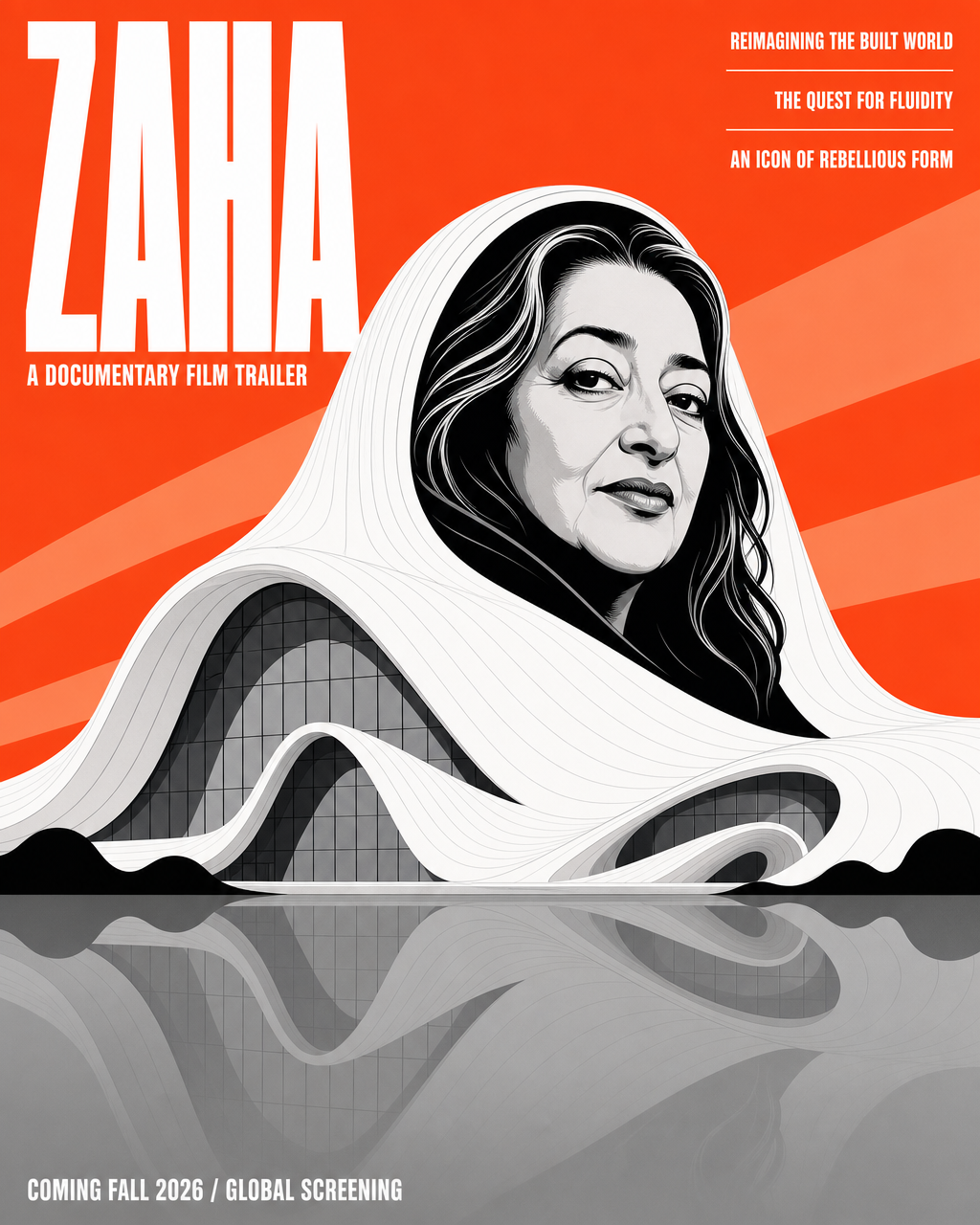
Flat vector documentary poster featuring an ingenious integration of architect and architecture: a high-contrast portrait of Zaha Hadid where the flowing, curved white (#FFFFFF) structure of the Heydar Aliyev Centre seamlessly sweeps up and around her, framing her face and serving as a stylized architectural headscarf. Palette: coral-orange (#FF5733), lighter orange (#FF8C66), white (#FFFFFF), black (#000000), neutral gray (#888888). Coral-orange (#FF5733) sky with lighter (#FF8C66) diagonal bands. Black (#000000) portrait shadows and bottom undulating amoeba silhouettes. Gray (#888888) ground plane.
Typography: Top-left: pure white (#FFFFFF) ultra-bold condensed Helvetica "ZAHA" in massive scale, flush to the left edge with generous top margin, tracking tightly closed. Directly beneath, same left alignment, smaller white Helvetica caps "A DOCUMENTARY FILM TRAILER" with tight leading. Top-right: three lines of small white (#FFFFFF) Helvetica caps, right-aligned to a consistent right margin, evenly spaced with ruled dividers between each line: "REIMAGINING THE BUILT WORLD" / "THE QUEST FOR FLUIDITY" / "AN ICON OF REBELLIOUS FORM". Bottom-left: crisp white (#FFFFFF) Helvetica bold caps "COMING FALL 2026 / GLOBAL SCREENING" anchored to bottom-left corner.
Reflection: Below the grey (#888888) horizon line, a vertically mirrored reflection of the Heydar Aliyev Centre and the undulating white architectural forms, rendered in reduced opacity (approx 40%) in cool grey tones, slightly blurred to simulate a still-water or polished-surface reflection. The black amoeba silhouettes at the base also reflect subtly upward into the grey ground plane, reinforcing the ground continuity. The reflection fades toward the bottom edge.
Clean lines, 2D flat vector illustration, screen-print aesthetic, 8k.
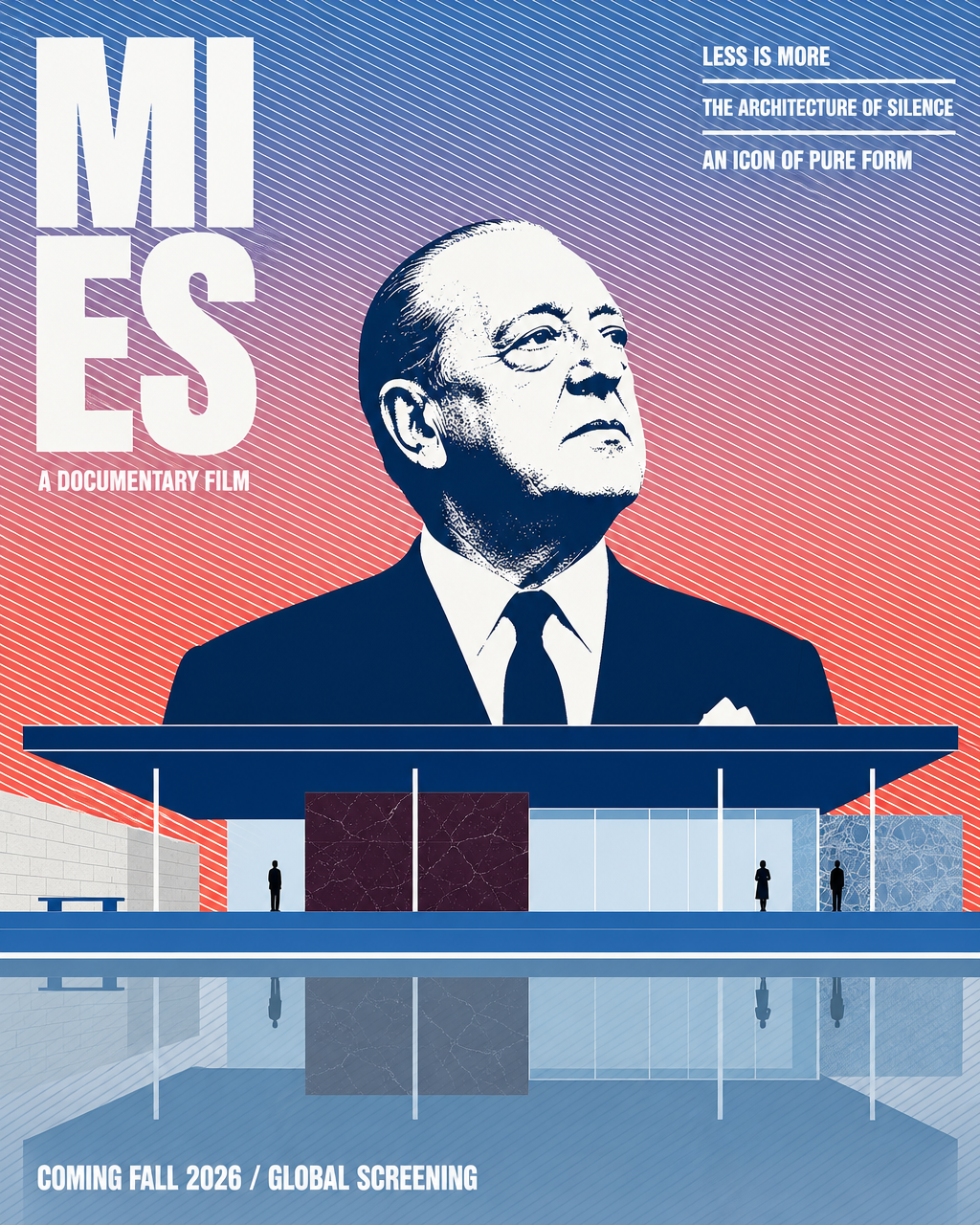
Flat vector documentary film poster. Subject: Ludwig Mies van der Rohe and the Barcelona Pavilion, 1929. Swiss editorial style. Portrait format.
Background: Full-bleed diagonal parallel line pattern — fine, evenly spaced lines running at approximately 15° angle across the entire poster. Lines shift in colour from cool steel blue (#4A7FB5) at top, transitioning through lavender-pink (#C47BA0) in the middle zone, to warm coral-red (#D94F3D) at lower sky. Background base is white (#FFFFFF) so stripes read as coloured lines over white. No photographic texture.
Architecture: Large-scale flat vector rendering of the Barcelona Pavilion occupying the lower half of the composition. Rendered as pure horizontal planes — flat roof slab in deep cobalt blue (#1B3F6E), raised podium platform in mid blue (#4A7FB5), thin cruciform steel columns as crisp white (#FFFFFF) vertical lines. The iconic freestanding onyx wall rendered as a bold flat rectangle in warm dark burgundy-charcoal (#2D1B2E). Glass walls suggested by near-transparent pale blue rectangles (#D6E8F5). Tiny black human silhouettes at ground level for scale. Composition is wide and low — the building hugs the bottom third of the poster.
Reflection: Directly below the building, the Barcelona Pavilion's reflecting pool rendered as a perfect vertical mirror of the architecture — 50% opacity, cool grey-blue tones (#8AAFC4), slightly compressed vertically to suggest a shallow still-water reflection. The diagonal stripe pattern from the sky also reflects faintly in the pool surface. Pool edges defined by a thin white line horizon.
Portrait integration: Mies van der Rohe as a high-contrast duotone portrait — two-tone in white (#FFFFFF) and deep navy (#0D2340) — positioned centrally above the building roofline, scaled large, gazing slightly upward and to the right. The flat roof plane of the pavilion cuts cleanly across the lower portion of his portrait, as if he is standing behind the building — architecture and figure composited on the same plane. No photographic quality; flat screen-print duotone treatment.
Typography: Top-left, white (#FFFFFF) ultra-bold condensed Helvetica or Akzidenz-Grotesk: enormous "MIES" stacked in two lines flush left. Below in smaller white caps: "A DOCUMENTARY FILM". Top-right, small white Helvetica caps in three stacked lines with thin ruled dividers: "LESS IS MORE" / "THE ARCHITECTURE OF SILENCE" / "AN ICON OF PURE FORM". Bottom-left anchored: white bold Helvetica caps "COMING FALL 2026 / GLOBAL SCREENING".
Overall: Clean 2D flat vector illustration. Screen-print aesthetic. No gradients within shapes — flat colour blocking only. Stripe pattern provides all tonal variation. 8k. No photographic textures.
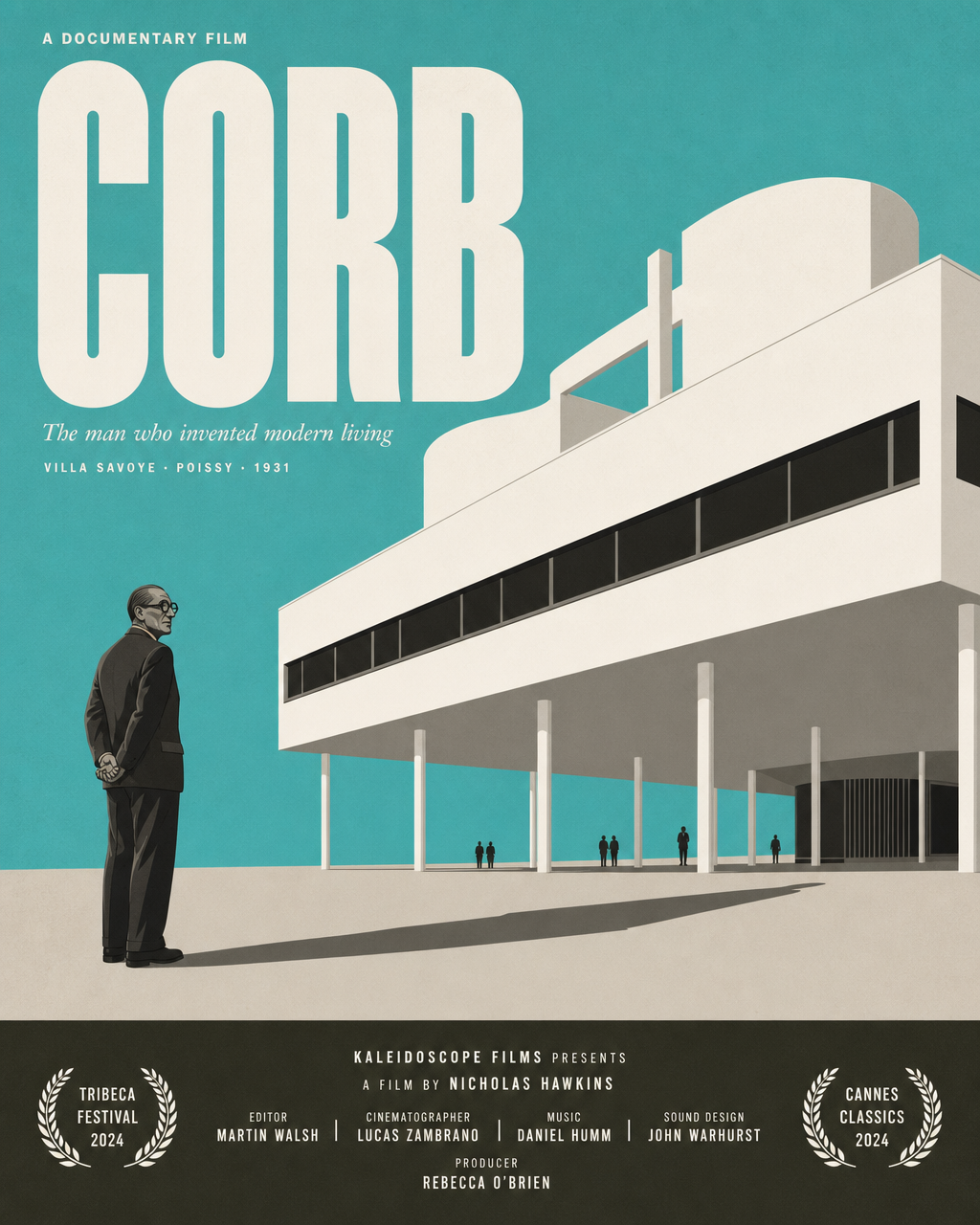
Flat vector documentary film poster. Subject: Le Corbusier and Villa Savoye, Poissy, 1931. Prestigious festival-quality documentary aesthetic. Portrait format.
Concept: Le Corbusier stands in the left foreground, small and contemplative, looking away from camera toward Villa Savoye behind him to the right. The building is the dominant element — large, partially cropped, bleeding off the right and bottom edges. The building has outgrown its creator. The man is dwarfed by what he made.
Perspective: Worm's-eye low angle — camera at ground level looking slightly upward. This makes both figure and building feel monumental despite their scale difference. The ground plane stretches wide between them.
Le Corbusier figure: Flat vector illustration. Dark charcoal suit (#2A2520) rendered in three flat tones — dark (#2A2520), mid (#4A4540), light edge highlight (#7A7570). Face in three-quarter view, partially turned toward us — round thick-framed spectacles clearly visible as circular shapes, strong profile, serious contemplative expression, hands clasped behind his back. He occupies the left third of the composition, his figure reaching no higher than 50–55% of the total poster height. He is present but not dominant. His long shadow stretches diagonally across the pale ground plane toward the building — dark grey (#4A4540), elongated, dramatic, connecting figure to architecture across the distance.
Villa Savoye: The dominant element — large, commanding, occupying the right two-thirds of the composition and bleeding off the right edge and bottom edge, partially cropped. Never fully contained within the frame. The iconic white horizontal box lifted on slender pilotis. Rendered in pure flat white (#F5F2EC) and light grey (#D8D4CC). Ribbon windows as a continuous dark horizontal band (#2A2520). Rooftop ramp and curved cylindrical windscreen parapet clearly visible above the roof line. Pilotis as clean thin white vertical columns with shadow sides in light grey (#C4C0B8). Shadow underside of the raised box in mid grey (#9E9890). The building feels immaculate, geometric, weightless — a machine for living, hovering above the earth. Approximately 2.5–3x the height of the Corbusier figure. The building is bigger than the man. The building outlasts the man.
Ground plane: Warm pale grey (#D8D4CC) stretching across the full width of the poster. Flat, minimal, vast. Corb's shadow reaches toward the building base. A few tiny anonymous human silhouettes in black near the building pilotis — reinforcing scale, suggesting habitation.
Sky: Flat teal-turquoise (#5EC8C8) — clean, no gradient, no texture. Fills the upper 45% of the poster. The building top and rooftop elements cut hard against the sky.
Typography — movie poster hierarchy:
Top-left anchored, small white (#FFFFFF) tracking-wide caps with generous margin: "A DOCUMENTARY FILM"
Ultra-bold cream-white (#F0EBE3) condensed Helvetica dominating the upper sky zone, large scale: "CORB" — single word, massive, commanding
Below title, centred, light italic white serif: "The man who invented modern living"
Small tracking-wide white caps below tagline: "VILLA SAVOYE · POISSY · 1931"
Bottom dark strip: full movie poster credits block in small condensed sans-serif white — production company name, director credit, editor, cinematographer, music, sound design, producer. Festival laurels (Tribeca Fest Festival 2024, Cannes Classics 2024) as circular line graphics anchored left and right of the credits strip.
Bottom edge: Dark olive-grey (#3A3A2A) credits strip — same treatment as previous successful output.
Texture: Subtle paper grain overlay at low opacity across entire poster — warm, printed, tactile quality.
Overall: Flat colour blocking throughout. Maximum three tones per surface family. No gradients within any shape. No photographic textures. Worm's-eye angle makes everything feel monumental. The building dominates the frame. The architect stands before it — small, certain, already looking toward the next thing. His shadow is the only thing that reaches it. Cinematic, contemplative, prestigious documentary quality. 8k.
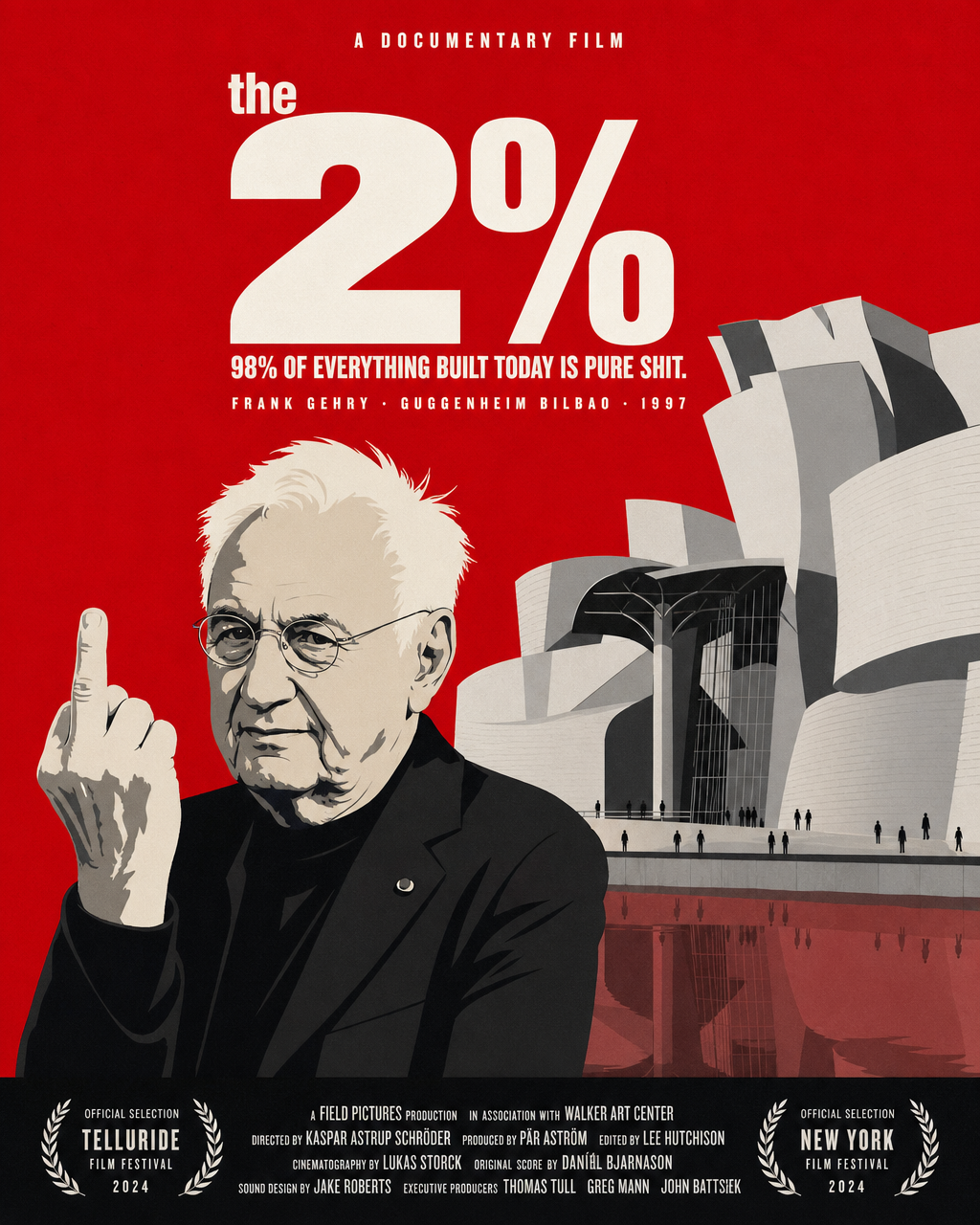
Flat vector documentary film poster. Subject: Frank Gehry and the Guggenheim Museum Bilbao. Provocative, punk-energy, festival documentary aesthetic. Portrait format.
Concept: Frank Gehry in the foreground raising his middle finger. Behind him, the Guggenheim Bilbao rises large and dominant — his greatest proof. One man. One building. One gesture.
Background: Flat blood red (#C0141E) — solid, uncompromising, wall-to-wall. No gradient, no texture.
Gehry figure: Large, left-centre foreground. Flat vector, three tones maximum — dark charcoal-black (#1A1A1A) jacket, mid grey (#6A6A6A) turned planes, off-white (#E8E4DC) face and hand highlight. Right arm raised, middle finger extended clearly upward — the compositional anchor. Round wire-framed spectacles as simple circular shapes, wild white hair in off-white. Casual, weary, unbothered. Flat screen-print treatment, no photographic realism.
Guggenheim Bilbao: Large, dominant, occupying the right two-thirds of the poster and bleeding off the right and top edges — never fully contained. Rendered in flat vector silhouette tones reading against the red: bright silver-white (#E8E8E8) highlight faces, mid silver-grey (#A8A8A8) turned surfaces, dark charcoal (#3A3A3A) deep shadow recesses. The characteristic flowing horizontal titanium curves — the central atrium tower, fish-scale petal forms, ribbon volumes — rendered as stacked overlapping flat shapes. No gradients within any shape. The building feels enormous, inevitable, irrefutable.
River: Nervión River at base as flat band of dark red-grey (#7A4A4A) — a muted reflection of the blood red sky. Simplified mirror reflection of the building forms compressed vertically at 40% opacity.
Tiny figures: Small black human silhouettes at plaza level along the building base — dwarfed, anonymous, scattered.
Typography — precise hierarchy:
Top centre, small white (#FFFFFF) tracking-wide caps: "A DOCUMENTARY FILM"
Main title, ultra-bold white (#FFFFFF) condensed Helvetica, maximum scale dominating the upper poster — two lines of differing size: "the" in small light weight directly above "2%" in massive bold weight. "the" is notably smaller, subordinate — almost a whisper before the declaration. Together they read as "The 2%"
Directly below, smaller bold white (#FFFFFF) condensed sans-serif subtitle: "98% OF EVERYTHING BUILT TODAY IS PURE SHIT."
Small white tracking-wide caps below: "FRANK GEHRY · GUGGENHEIM BILBAO · 1997"
Bottom black credits strip (#1A1A1A): full movie poster credits block — small condensed white sans-serif. Festival laurels (Telluride, New York Film Festival) either side
Texture: Subtle paper grain overlay at low opacity — silkscreen, printed quality.
Overall: Flat colour blocking throughout, maximum three tones per surface, no gradients. Blood red total. Gehry's finger foreground left. Bilbao dominant right. "the" small, "2%" massive. The subtitle lands like a verdict. The building is the only evidence needed. 8k.
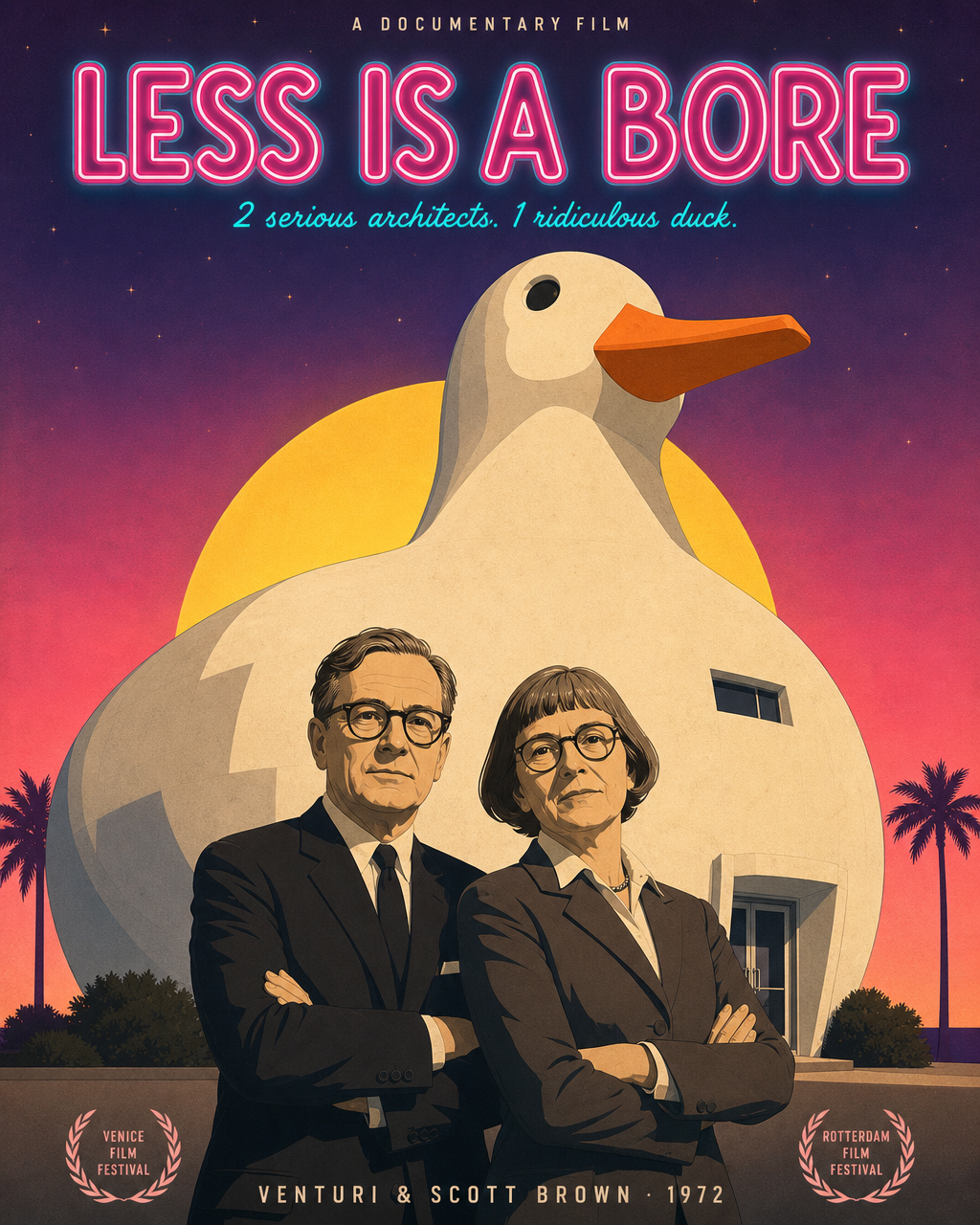
Postmodern documentary film poster. Subject: Robert Venturi and Denise Scott Brown, Learning from Las Vegas, 1972. Cinematic, witty, curiosity-driven. Portrait format.
Concept: Two architects stand together in the foreground, dressed sharply, posed with quiet pride and total seriousness — presenting, as if it were a masterpiece, the enormous duck-shaped building rising behind them. The humour is entirely in the situation: two distinguished intellectuals standing reverently before a giant roadside duck. No labels, no explanation, no signage spelling out the joke. The image creates curiosity — who are they, and why are they so proud of this duck? The absurdity is the argument.
Composition: Cinematic wide shot. Venturi and Scott Brown stand together in the lower foreground, roughly centred, at medium scale — full or three-quarter figures, side by side, a couple and a partnership. Behind and above them rises the colossal duck building, dominating the upper two-thirds of the frame, monumental against the sky. The scale contrast — human figures and the giant absurd duck — is the composition. They look toward the viewer or gaze up at the duck with calm conviction.
The two architects: Robert Venturi and Denise Scott Brown rendered as flat vector figures, equal in scale and prominence, standing close together as partners. He in a dark suit and glasses; she in a smart jacket and glasses, distinctive and dignified. Their expressions: serious, proud, unironic — they clearly believe in this duck completely, which is exactly what makes it funny. Rendered in clean flat vector with limited tonal planes — dark suit tones (#2A2A2A, #4A4540), cream skin highlights (#E8D8C0), enough character that they read as specific, dignified people.
The duck building: A colossal duck-shaped building rising behind them — a plump white stylised duck structure standing upright, body forming the architecture, small windows and a door set into it, an orange beak, a single round eye. Monumental, absurd, presented with total sincerity. Clean flat vector: cream-white body (#F5EFE0), warm orange beak (#E8743B), soft grey shadow planes (#C8C4BC). It looms large and proud, lit warmly.
Background: Flat Las Vegas dusk sky — smooth gradient from warm postmodern pink (#F0468C) at the horizon to deep blue-violet (#3A2E5C) at top. A glowing yellow sun-disc (#F2C24E) low behind the duck, backlighting it. A scatter of small flat stars. Two minimal flat palm silhouettes (#2A1E3C) at the edges. A thin ground line. The duck is the warm glowing focal point against the cooling sky.
Typography — minimal, lets the image breathe:
Top centre, small cream (#F5EFE0) tracking-wide caps: "A DOCUMENTARY FILM"
Main title in glowing neon-style lettering, hot pink (#F0468C) with thin cyan (#2BC4E8) outline glow, bold rounded retro signage font: "LESS IS A BORE"
Below, small italic script tagline in cyan (#2BC4E8): "Learning from Las Vegas"
Small caps credit line at the base: "VENTURI & SCOTT BROWN · 1972"
Two small festival laurel stamps (Venice, Rotterdam) near the bottom corners — circular line graphics only, NO credits banner, NO explanatory signage anywhere.
Texture: Subtle paper grain at low opacity — aged 1972 print quality.
Overall: Flat vector, postmodern Vegas palette, cinematic and curiosity-driven. Two dignified architects standing proudly before a giant absurd duck building — the joke is in the image, never explained. Warm glowing duck against a pink-violet dusk. Minimal typography. The viewer should be intrigued, amused, and want to know the story. NOT a busy collage, NO labels. 8k.
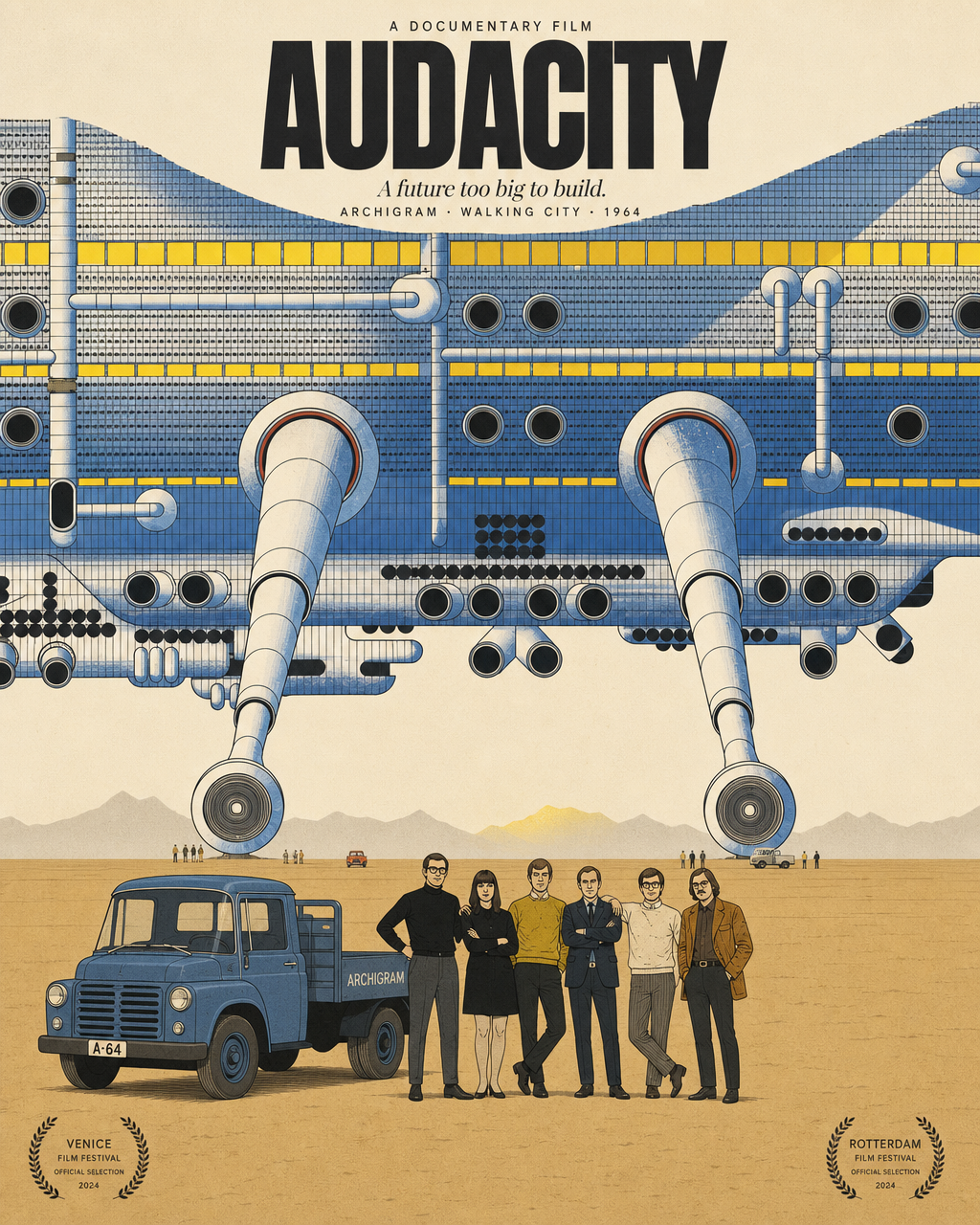
Flat vector documentary film poster. Subject: Archigram's Walking City, 1964, by Ron Herron. Faithful Herron proportion, punched in close so the machine feels limitlessly gargantuan. Portrait format.
Push in tight: We stand directly beneath the Walking City, very close, looking up. The machine is cropped HARD — the entire top of the body, the domed humps, and the upper hull all bleed OFF the top edge of the frame and off both side edges. We see only the massive lower belly of the hull and the legs descending to the ground. The body extends beyond the frame in every upward direction. The hull occupies the upper two-thirds as a cropped wall of machinery; the legs and ground occupy the lower third.
The machine — faithful to the reference: Smooth body-dominant ovoid hull (cropped at top) in fine drawn grid texture, soft cornflower blue (#5A7FC4), pale grey-white (#E8ECF2), warm yellow accent stripes (#F2D44E), rows of round portholes. The legs and disc feet exactly as in the reference drawing — match their form and proportion faithfully. NO platform, NO base, NO plinth where the legs meet the ground — the legs plant directly into the flat desert ground with disc feet only, no raised platform or stage beneath them.
Archigram team in foreground: In the near foreground, beside and slightly behind the truck, a small group of 5-6 figures standing together posing for a group photograph — the Archigram team. They are dressed in 1960s clothing — smart casual, period-appropriate. They face the camera directly, relaxed and confident, as if this is a normal team photo and the colossal machine behind them is simply where they work. They are rendered as clean flat vector figures with enough character to read as a distinct group of people — varied heights, period silhouettes, some with their arms around each other or hands in pockets. They are human-scale and legible but still dramatically dwarfed by the machine looming above and behind them. The contrast between their casual posed confidence and the impossible structure overhead is the emotional hook.
Foreground scale anchor: The blue truck remains prominently in the near foreground — large, legible, clearly a truck. The Archigram team stands beside it or slightly behind it, same depth layer. Together the truck and the team form the near foreground scale anchor.
Layered depth: Near foreground (truck + Archigram team posing) → tiny human figures and vehicles at the disc feet → machine hull → mountain range fading into haze. The eye steps back through four depth layers.
Mountain range background: Low flat silhouette of a mountain range in pale cool grey (#B8B4AC) fading into atmospheric haze at the horizon. The Walking City's hull and legs are TALLER than the mountain peaks. Simple flat profile, no detail.
Atmospheric depth: Pale cream-grey haze (#E4E0D8) behind the machine and across the far ground — near forms crisp, far mountains barely visible through mist.
Background: Thin sliver of pale cream-white sky (#F5EFE0) at top, mostly filled by the cropped hull. Soft yellow sun-glow leaking through a gap. Wide flat warm tan ground plane (#C4A878) across the lower third.
Typography:
Top, small charcoal (#2A2A2A) tracking-wide caps: "A DOCUMENTARY FILM"
Ultra-bold charcoal (#2A2A2A) condensed Helvetica: "AUDACITY" — set against the thin top sky sliver
Below, light italic charcoal serif: "A future too big to build."
Small charcoal tracking-wide caps: "ARCHIGRAM · WALKING CITY · 1964"
Two small festival laurel stamps (Venice, Rotterdam) near bottom corners — circular line graphics only, NO credits banner.
Texture: Subtle paper grain at low opacity — aged 1964 technical-drawing print quality.
Overall: Flat vector, faithful reference proportion, punched in close. NO platform bases at the leg feet — legs plant directly into desert ground. Near foreground: truck + Archigram team posing casually for camera, dwarfed by the machine. Four depth layers. Machine overtops the mountains. Atmospheric haze. We stand beneath a structure the scale of a mountain range. 8k.
All six generated with GPT Image 2. The recurring moves: a hex-locked palette, flat vector planes instead of photography, a reflection or shadow tying figure to building, and the full movie-poster type hierarchy — title, tagline, subject line, festival laurels.
Want the workflow behind these? See the rest of the resources.