Transition from AI slop to Engagement.
Two charts of the same practice. The middle stage is identical in both. The two ends decide what the work is worth.
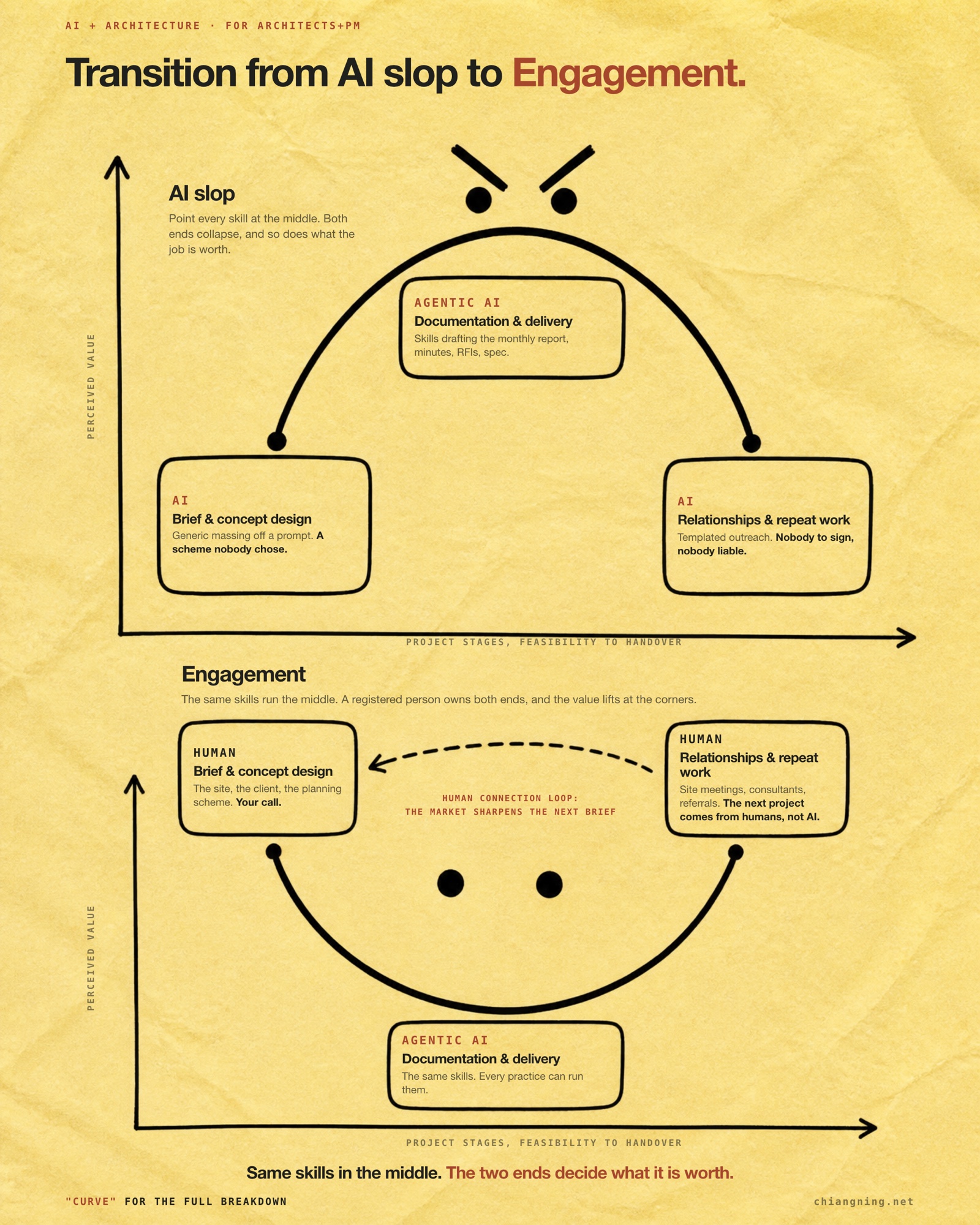
Agentic AI is spectacular at the middle of a project, and the middle of a project is the part that stopped paying.
That sentence sounds like a complaint. It isn't. It is the most useful thing I have worked out about running a practice with AI in it, and once you see it, where to put your own hours becomes obvious.
Draw a project left to right, feasibility through handover. Ask where the value sits. You get one of 2 shapes, and which one you get has nothing to do with how much AI you use. 5% AI or 95% AI, the shape is set by 2 questions: who owns the brief, and who signs the work.
Two things before we start
- Save this. It is a way to look at your own fee, not a tool review.
- Send it to 1 person in your practice who is automating the wrong end.
01What the 2 axes mean
Across the bottom is the job, feasibility to handover. Nothing clever there.
Up the side is perceived value. Not hours, not effort, not how hard the stage was. It is what the client assigns to that stage with their attention, their money and their trust. You do not set it. They do, and they do it partly by comparing you to everyone else who could have done the same stage.
That second half is the whole argument. A stage is worth what it is worth relative to who else can do it. The moment a stage becomes available to every practice in the city, its price falls, no matter how good you are at it.
Value follows scarcity, not difficulty. AI made a hard stage easy, and easy is not scarce.
This shape has an ancestor. In 1992 Stan Shih, who founded Acer, drew the smile curve to explain the PC industry: value concentrated at the ends, research and design at one end, brand and distribution at the other, while assembly in the middle earned the least. The AI content version that prompted this piece is Tianyu Xu's. What follows is that same shape applied to an architectural practice, which is where I actually work.
Same 3 stages on both charts. Same axis. The only thing that changes is who is standing at each one.
02Chart 1: AI slop
AI at all 3 stages · the frown
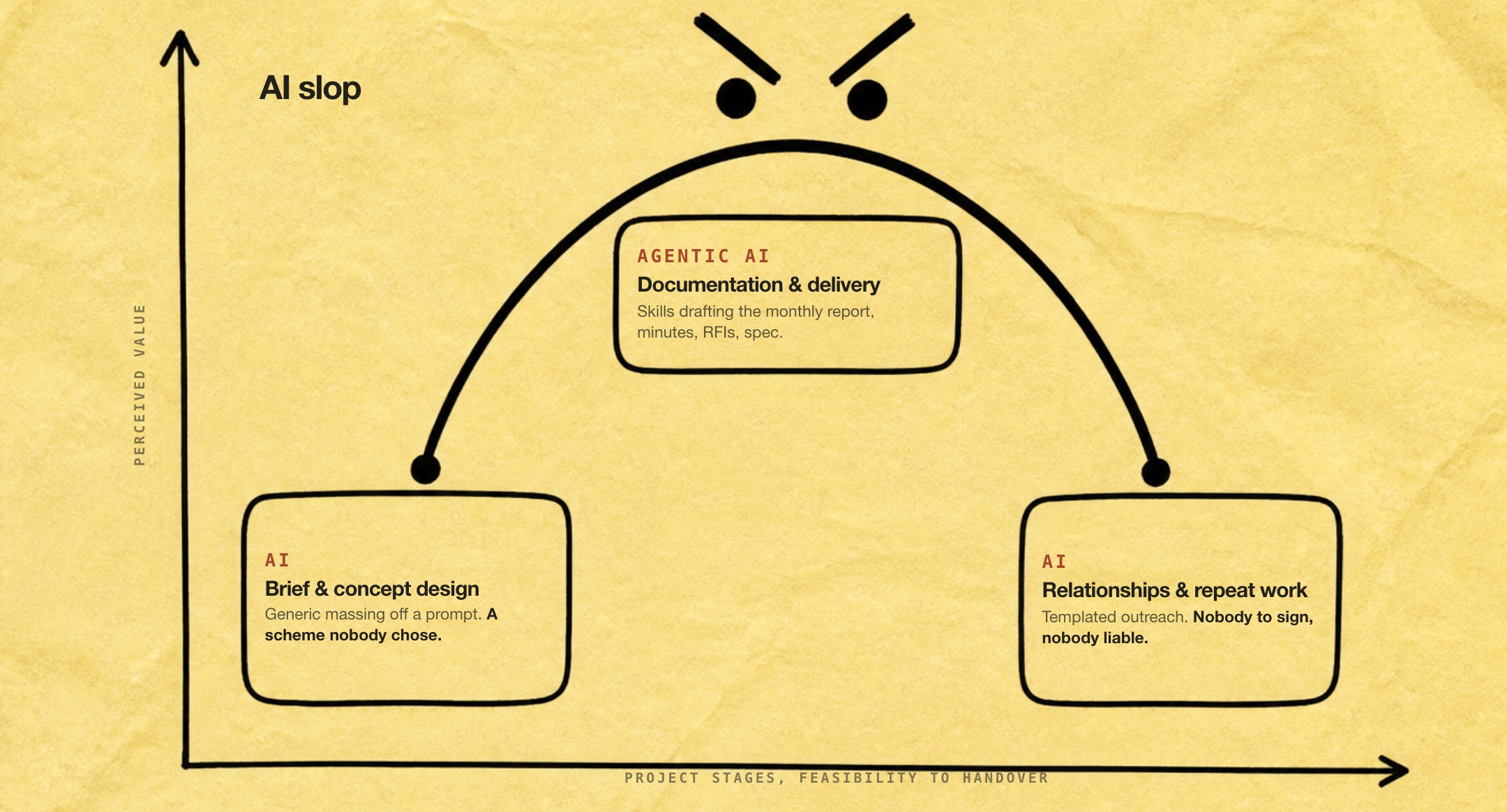
Read the shape first. Value humps in the middle and falls away at both ends. That is not a drawing error. It is what an all-AI pipeline actually produces.
The middle is high because it is the only stage still producing something. Documentation comes out, and it comes out fast. The ends produce nothing anyone values: a concept nobody chose, and outreach nobody answers. So the entire value of the pipeline concentrates in the one stage where you have no advantage over any other practice.
That is the trap in a sentence. Your whole offer becomes the commodity. And the moment a client works that out, the conversation is only ever about price, because you have handed them the argument that anyone could have done it.
Stage by stage, what actually goes wrong
Brief and concept design. Generic massing off a prompt. Every model was trained on the same material, so 100 architects with the same prompt get 100 versions of the same scheme, and behind it sit decisions nobody actually made.
Documentation and delivery. More output than anyone can check, so nobody checks all of it. The speed is real. The review capacity did not scale with it.
Relationships and repeat work. Templated outreach sent to people who can tell. Nobody to sign, nobody liable, nothing for the client to trust.
It rarely arrives as a decision. It arrives as 3 small conveniences in a busy month.
A concept generated from a prompt because the fee was thin and the deadline was Friday.
A set produced faster than anyone can check, on a job where nobody had time to check it anyway.
Follow-ups written by a model, because there were 40 of them and Thursday was gone.
The honest part: this is not the pipeline of a lazy practice. It is usually the pipeline of a practice trying very hard under fee pressure, automating in the order that feels easiest rather than the order that protects the fee.
03Chart 2: Engagement
A person at both ends · the smile
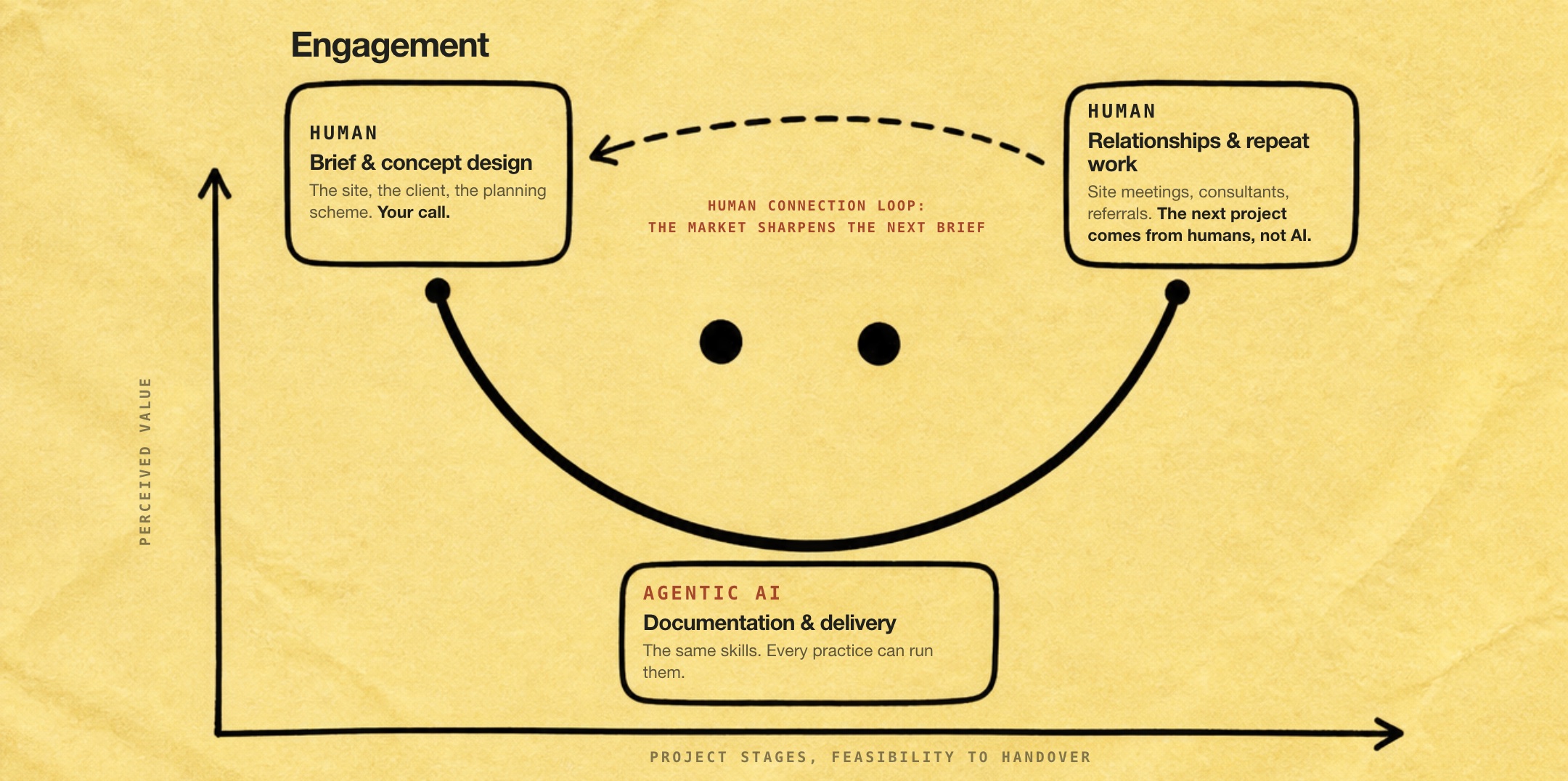
Same 3 stages. Same agentic AI doing the middle, with the same skills. The shape inverts anyway.
It inverts because the 2 ends are now producing something scarce. A brief that came from a person who has stood on the site. Relationships with people who will appoint you again. Neither is available to the practice down the road by installing anything.
Notice what did not change. The middle is the same work, done the same way, at the same speed. Automation is not the variable. Ownership of the 2 ends is.
The loop
The dashed arrow runs from the right end back to the left, and it is the part that compounds. What you learn on site, in the handover meeting, in the consultant's complaint about your detail, in the referral that came from a builder you were straight with, all of it goes into the next brief. The market tells you what it actually wants and your next brief gets sharper.
The slop chart has no loop. Nothing comes back, because nobody was in the room to hear it.
The next 3 sections are the same 3 stages, one at a time, with what I actually run at each.
04The middle, and why it stopped paying
Documentation and delivery · agentic AI
This is the stage AI is genuinely brilliant at, and I am not hedging. Monthly reports, meeting minutes, RFI drafts, spec sections, drawing schedules, EOI responses, the first pass of a fee proposal. Work that used to eat a Friday now runs while you are on site.
I build skills for exactly this. A skill is a written instruction file that turns a repeatable task into something you invoke instead of re-explaining. The monthly report skill reads the month's material and produces the report in our format, every time, without me rebuilding the prompt.
I do this task every month and I want it written up as a reusable skill.

The task: [monthly project report for a construction client]
What I feed it: [site photos, the last report, the contractor's claim, my notes]
What comes out: [a 4 page report in our house format]

Interview me first. Ask me the questions you need answered to write
this properly, one at a time, and do not start writing until you have
enough. Then produce the skill file: purpose, inputs, the steps in
order, the house rules, and the checks before it is handed to me.

House rules that always apply:
- Australian English, no em dashes.
- Never invent a number, a date or a name. Mark anything missing as
  [TO CONFIRM] instead of filling the gap.
- Flag anything a consultant must verify.
So why does the best stage sit at the bottom of the smile?
Because your competitor down the road can now do it too. Not slightly. Identically. The same models, the same skills, the same weekend to set them up. When a capability arrives everywhere at once, it stops being a reason to hire you and becomes the price of being in the room.
Manufacturing went through this. Once anyone could assemble the box, assembly stopped commanding a premium. Assembly did not become useless. It became expected.
Read this correctly: the middle did not lose its purpose, it lost its pricing power. Those are different things. It is still where your leverage comes from. An hour of your judgement at the front now directs 100 hours of production instead of 10. Just do not expect the client to pay for the 100 hours the way they used to.
05The left end: the brief
The site, the client, the planning scheme · human
What a model has never done: stood on the site at 4pm and watched where the shadow lands. Sat through the client's third change of mind and worked out what they actually want. Read the planning scheme and known which control the officer will really push on. Carried a project through a build and learned which detail fails.
Using AI to sharpen your idea is a different act from asking AI for 100 ideas and picking one. The first makes you better. The second makes you identical to everyone else who did the same thing that morning.
So the useful move at this end is not generation. It is interrogation. Write the brief yourself, then have the model attack it.
Here is my brief for [project]. Do not improve it and do not
write anything for me.

[paste the brief]

Your job is to find where it is vague, where it contradicts itself,
and where I have assumed something nobody has confirmed.

Give me:
1. Every decision that has been left unstated.
2. Every number in here that is not evidenced, including the ones I
   sound confident about.
3. The 3 questions I should ask the client before any design work.
4. What in this brief would embarrass me in front of a planner.

If something here is simply wrong, say so plainly. Do not soften it.
The one mistake: letting the model write the brief because the blank page is uncomfortable. The blank page is the job. A brief you did not write is a brief you cannot defend when the client pushes back in month 4.
06The right end: relationships
Site meetings, consultants, referrals · human
This is the end most charts leave off, and in a practice it is where the next fee comes from.
Nobody appoints an architect because of an email sequence. They appoint you because a builder mentioned you, because a consultant liked working with you on the last job, because a client at handover would use you again. That is built in rooms, on site, over years, and it does not automate.
The other half of this end is accountability. Somebody registered signs the drawings. Somebody carries the insurance. Somebody stands in front of the client when it goes wrong, and it is never the model. That signature is not admin at the end of the process. It is a large part of what the client is buying.
AI still helps here. It just sits behind you, not in front of the client.
I have a meeting with [client / consultant / builder] about
[project] on [date].

Using only the project material I have given you, prepare me:
- What we promised them last time, and whether we did it.
- Every open item they are waiting on from us, oldest first.
- The 2 things most likely to be raised that we are not ready for.
- The decisions I need from them, with the cost of not deciding.

Do not draft what I should say. I am running the meeting.
List anything you could not confirm from the material as UNKNOWN.
The one mistake: using a model to produce the relationship rather than to prepare for it. The second is leverage. The first is the fastest way to become forgettable.
07The transition, in 3 moves
You do not need a strategy day for this. You need to move your own hours.
1. Automate the middle, deliberately and completely
Pick the 3 tasks in your month that are repeatable, format-driven and unloved. Reports, minutes, schedules, first-pass specs. Turn each into a skill rather than a prompt you rewrite. Measure the hours you get back, because those hours are the point.
2. Spend the recovered hours at the 2 ends
This is the move almost everyone misses. The time freed in the middle gets absorbed by more middle, more options, more output, more revisions. Put it into site visits, into the brief, into the awkward call with the client about what they actually want, into the coffee with the builder. That is where it converts to fee.
3. Keep the signature obvious
Be plain with clients about how the work is made. AI produced the options and the first drafts, a registered person made the calls and signs the set. Said out loud, that is a reason to appoint you rather than something to hide.
The monthly report workflow · Skills worth building first · Set the account up properly first
What this doesn't do
None of this makes the work good. A human at both ends of a bad project is still a bad project, and there are plenty of practices producing forgettable buildings with no AI in the pipeline at all.
The curve is also not a fee schedule. It says where value concentrates, not what to charge. And on genuinely commodity work, where the client wants the cheapest compliant version and nothing else, automating the whole chain is rational and the curve flattens. The smile only appears when the work has to be distinctly yours.
The last honest note: I sell AI training and setup to practices. That is my commercial interest, and it points the same way as the advice. The practices that get value from me are the ones automating the middle and then spending the recovered time at the ends. The ones automating all 3 stages do not need me. They need a client who cannot tell the difference, and those are getting harder to find.
Every project you deliver draws one of these 2 curves in public. The client always sees which one.
The 2 ends are what you sell.
Send this to 1 person in your practice who is automating the wrong end.
I run AI setup and skill-building sessions for practices doing this internally. That is the business. Everything here is free regardless.