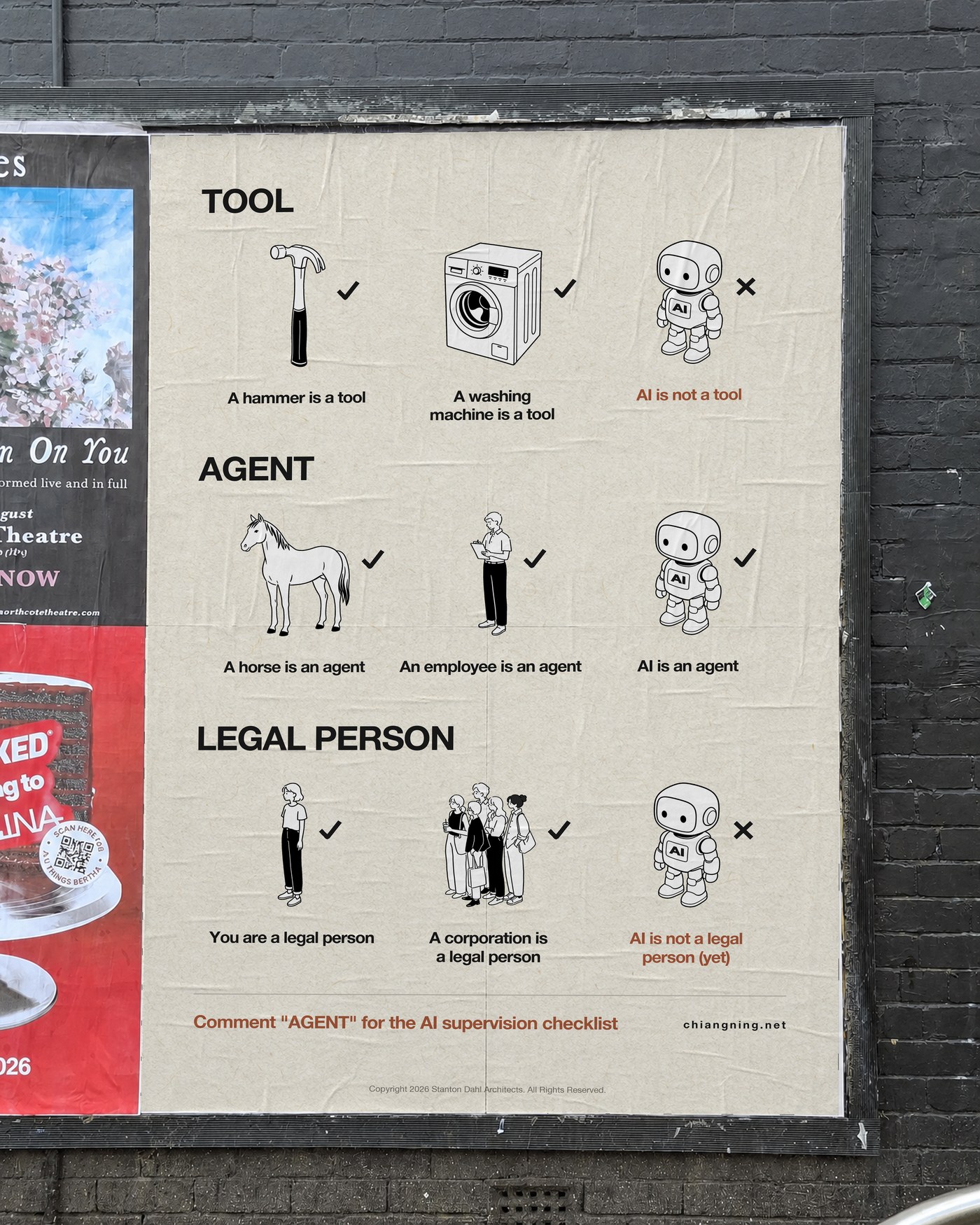
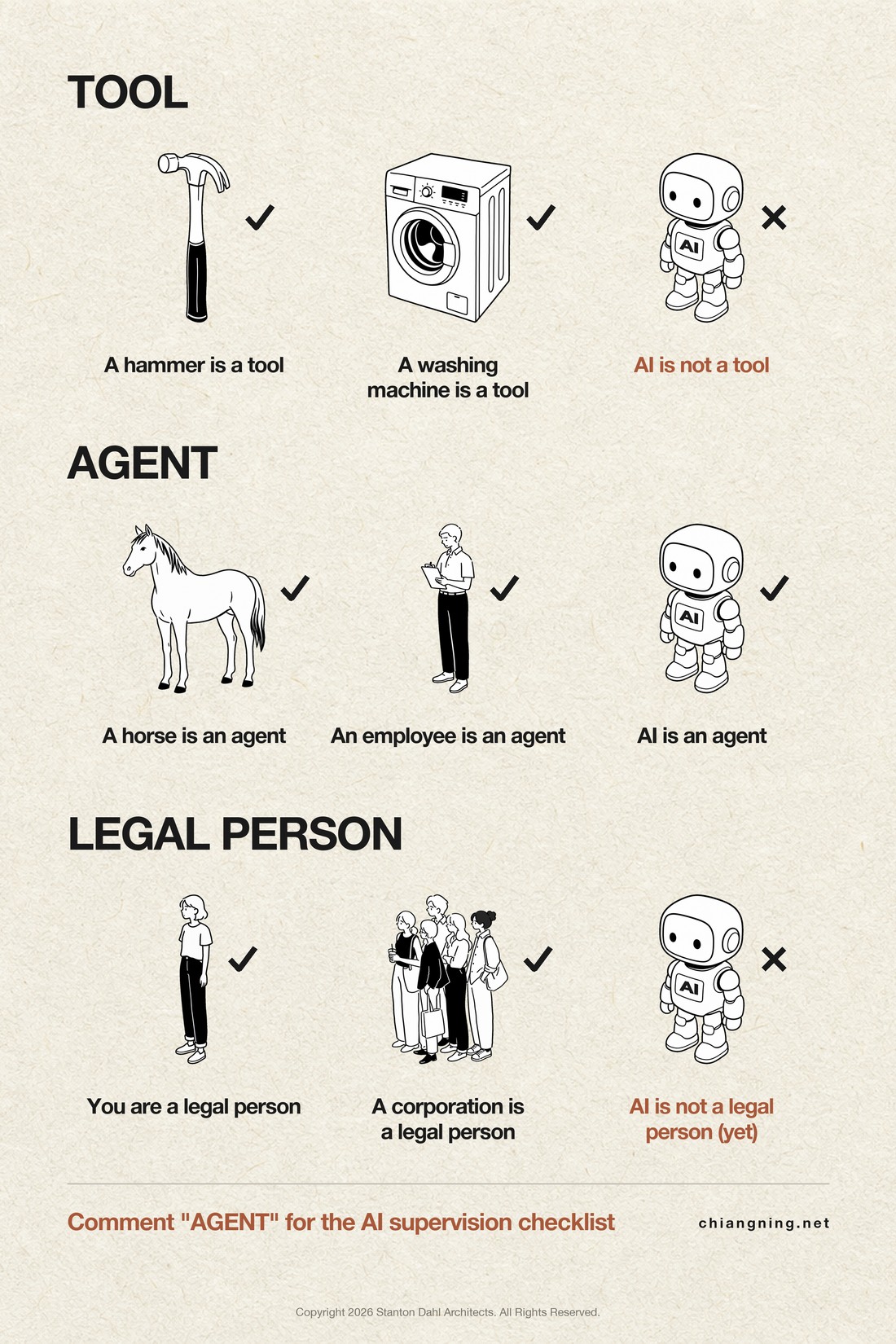
AI is not a tool. It is an agent you cannot sue.
Three categories, one gap, and the supervision checklist that closes it.
"It's just a tool."
I hear it every week. Usually from someone senior. Usually said to close the conversation rather than open it.
It is the most comfortable thing you can say about AI. It is also the least accurate, and the comfort is exactly the problem, because the category you put something in decides how carefully you check it.
Nobody checks a hammer's work.
So if you have filed AI under tool, you have quietly given yourself permission to stop reading its output closely. That is the risk. Not the technology. The filing.
Two things before we start
- Save this page. The checklist in section 04 is the part to keep.
- Send it to whoever in your practice signs the drawings. They are the one carrying this.
01A tool does not think
A hammer does the same job, the same way, every time.
It has no view on whether you should be driving that nail. Swing it at the wrong thing and it will drive the nail into the wrong thing, perfectly.
A washing machine is the same. It needs no intelligence. Load it wrong and it will wash the wrong load without hesitating.
That is what a tool is. No judgement. No initiative. No opinion about your work.
Its behaviour is fully determined by your input, which is why you never have to review what it produced. You only have to review what you fed it.
Can it surprise you? A tool cannot. If the thing in front of you can hand back something you did not anticipate and could not have predicted from your input, it is not a tool, whatever the vendor calls it.
02An agent does
An agent acts on your behalf, using its own intelligence to get there.
A horse is an agent. It carries you from one place to another and picks its own footing on the way. You can train it. You can direct it. You cannot reduce it to a dumb tool, because between your instruction and the outcome sits its own judgement about where to put its feet.
A graduate architect is an agent. You hire them expecting they can finish a task using their own intelligence, their qualifications and their training. You give them a brief, not a set of keystrokes.
And then you check the drawings.
Not because you distrust them. Because that is what supervising an agent means. The whole structure of an architectural practice is built on this: competent people exercising judgement, and a review layer above them that catches what the judgement missed.
That is exactly the relationship you already have with AI. Whether you filed it that way or not.
You are already supervising an agent. The only question is whether you set up the review layer, or skipped it because you called it a tool.
03The gap nobody names
Here is where the comparison breaks, and it breaks in the direction that matters to you.
A legal person can own things. A corporation owns buildings, holds contracts, carries insurance. A legal person is also accountable: registered, named in a claim, sued for negligence, disciplined by a board.
Your graduate architect is a legal person. So is your consultant. So is the builder.
AI is none of that.
So you are supervising an agent with no legal standing behind it.
Every judgement it makes lands back on your name. Not on the vendor's, in any practical sense, and certainly not on the model's. On the registration of whoever signed.
That is not an argument against using it. I use it daily, in live work. It is an argument for supervising it properly, because it is the only participant in your workflow that carries an agent's influence with a tool's accountability.
Worth saying plainly: this is a way of thinking about responsibility in your own practice, not legal advice. If you are drafting AI clauses into your appointments or your PI cover, get your insurer and your lawyer to write those words, not me and not a model.
04The supervision checklist
This is the part to keep. Ten checks, drawn from the way you already supervise a graduate, applied to the agent that cannot be sued.
None of it is clever. That is the point. Nobody loses a job to AI doing something brilliant and wrong. They lose it to AI doing something plausible and unchecked.
The ten checks
- Brief it, do not query it. Give scope, constraints, stage and the deliverable, the way you would brief a graduate on a Monday. A one-line question gets a one-line quality answer.
- Give it the source documents. The planning scheme, the brief, the standard, the client's email. Anything it recalls from memory instead of reading is a claim, not a fact.
- Make it cite where each number came from. Document and section. If it cannot name the source, treat the number as unverified.
- Force it to separate fact from inference. The dangerous output is not the wrong answer. It is the reasonable-sounding bridge between two right ones.
- Ignore its confidence entirely. It reads the same when it is right and when it is inventing. Confidence carries no information here, unlike with a graduate, where hesitation tells you something real.
- Check anything dimensional or quantitative independently. Areas, setbacks, heights, quantities, ratios. Independently means a second method, not asking it again.
- Verify every code or authority claim at the source. Open the clause. Every time. This is the single highest-consequence check on the list.
- Decide up front what it never touches. Write the list down. Certification, statements of compliance, anything that goes out under a signature without a human pass. A boundary decided in advance survives a deadline; one decided at 11pm does not.
- Keep the review trail. What you asked, what it produced, what you changed. If a decision is ever questioned, the trail is what shows a competent person exercised judgement over it.
- Name the reviewer. Every AI-assisted output that leaves the office has a person who read it properly. Not "the team". A name.
Two prompts make most of that automatic. The first sets the supervision terms before the work starts. The second runs the red-pen pass afterwards.
You are working as a graduate on my team, not as a search engine.

Task: [what you want done]
Project: [type, scale, location, stage]
Source documents: I am giving you [list them]. Use ONLY these. If an
answer is not in them, say "not in the documents" rather than filling
the gap.

Rules for everything you produce:
1. Show where each number, clause or requirement came from. Name the
   document and the section.
2. Separate what the documents say from what you are inferring, and
   label the inferences as inferences.
3. List every assumption you had to make, at the end, as a short list.
4. Flag anything a registered architect must verify before it is issued.
5. Do not smooth over a gap. A missing input is the useful finding.

Australian English. No filler, no preamble.
Here is the output you just gave me:
[PASTE IT BACK]

Review it as the reviewer, not the author.

1. List every claim that is not directly supported by the source
   documents I gave you.
2. For each one, say exactly what would have to be checked, and where.
3. Rank the 5 items most likely to cause a real problem if they are
   wrong, worst first.
4. Say plainly which parts of this must not be issued without a
   registered architect signing off.

Be blunt. I want the failure list, not reassurance.
What you get: a graduate's work with the graduate's own list of what they were unsure about. Which is more than most graduates give you.
Check it: the red-pen pass is still the agent marking its own homework. It catches the obvious gaps and misses the ones it does not know it has. It shortens your review. It does not replace it.
05What to change this week
Three things, none of which need a policy document.
Stop saying "just a tool" in the office
Language sets the review standard. The moment a junior hears AI described as a tool, they stop checking it like an agent. Say "it is an agent, check it like a graduate" and the behaviour follows the sentence.
Write the never-touch list
One page. What AI is not allowed near in your practice, decided calmly rather than under deadline. Circulate it. Nobody has to guess where the line is at 11pm on a lodgement night.
Put a name on AI-assisted output
Not a disclaimer. A reviewer. The check that already exists for a graduate's drawing, applied to the same work when an agent produced it. This costs nothing and is the difference between supervised and unsupervised in every sense that matters later.
The part that stays with you
AI will keep getting better at the work. It will not start being accountable for it.
That gap is not a temporary bug that the next model closes. It is a category difference, and it is the reason your registration still means something.
You read the room. You know which drawing to show. You carry the consequence.
That part does not download.
Call it a tool and you will not check its work. Call it an agent and you will.
Supervise it like a graduate.
Comment "AGENT" on the post and I will send you the supervision checklist as a one-page file you can pin up.
And if the person who signs your drawings has not thought about this, send it to them. That is the one who needs it.